
Beginner case file
How to play deduction sudoku
Doña Lupa is an iPhone deduction game that replaces sudoku numbers with illustrated suspects. Place one suspect in each row, column and zone, then cross the case's truthful clues to find the unique solution. The easy cases let you learn the format before choosing monthly access or a lifetime unlock.
A deduction sudoku is a logic puzzle where every suspect appears once in each row, column and outlined zone. Read the clues, rule out impossible cells, and keep applying those three board constraints until everybody has exactly one place to stand.
Deduction sudoku rules in plain English
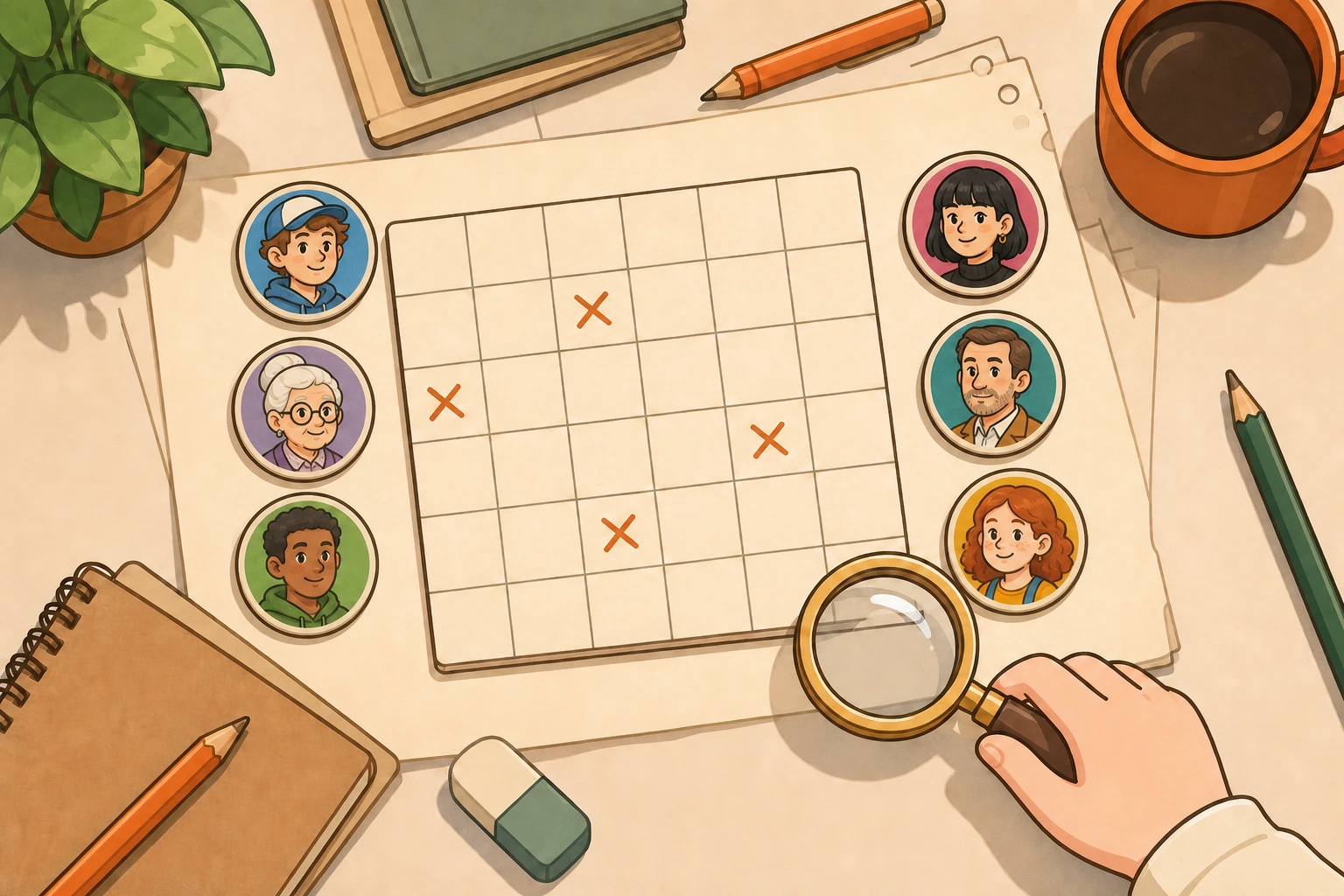
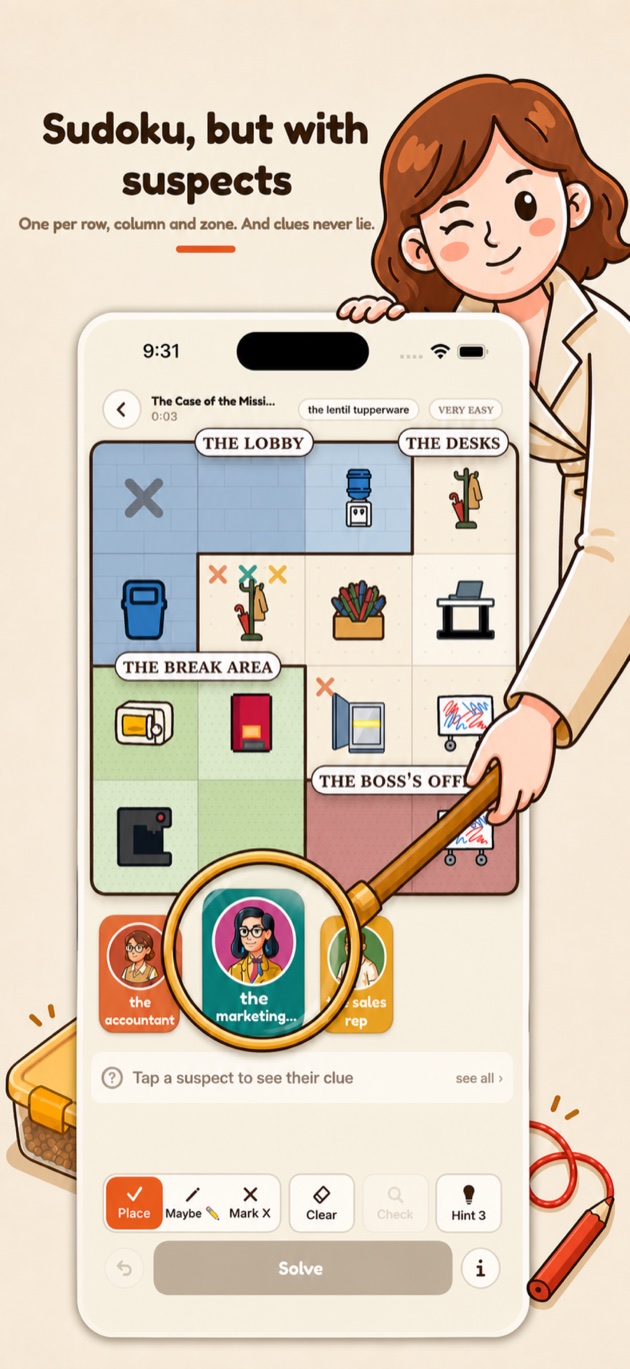
Start with the grid. Instead of the digits used in a standard sudoku, Doña Lupa gives you a cast of illustrated suspects. If a case has six suspects, each row must contain all six once, each column must contain all six once, and every thickly outlined zone must also contain all six once. A suspect cannot repeat inside any of those three groups.
The zones are the part new players most often overlook. They may be square, long, bent or split across an area that looks awkward at first glance. Trace the heavy border before placing anyone. A cell belongs simultaneously to one row, one column and one zone, so every placement affects three parts of the board.
A reliable way to solve your first case
1. Scan before you place
Note the suspects, the zone shapes and any faces already on the board. Look for a row, column or zone that is nearly complete. If five different suspects already occupy a six-cell group, the empty cell is forced even without a story clue.
2. Use the most direct clues first
A clue may identify where someone is, where they are not, or how two facts relate. Apply statements that force a single cell before vague-looking relationships. When a clue rules out a cell, mark the impossibility instead of trying to remember it. Visible notes stop you from reopening a dead lead later.
3. Let each placement travel
Suppose you place the intern in the top-left cell. The intern can no longer appear anywhere else in that row, that column or that zone. Mark those exclusions immediately. One answer often creates another forced cell, which creates a third. This chain reaction is the real engine of deduction sudoku.
4. Alternate clues and constraints
Do not read every clue once and then abandon the story. A clue that seemed unhelpful may become decisive after the board narrows. Cycle between the clue list and the grid: place, eliminate, rescan, then return to the remaining clues.
Try the method on a real case
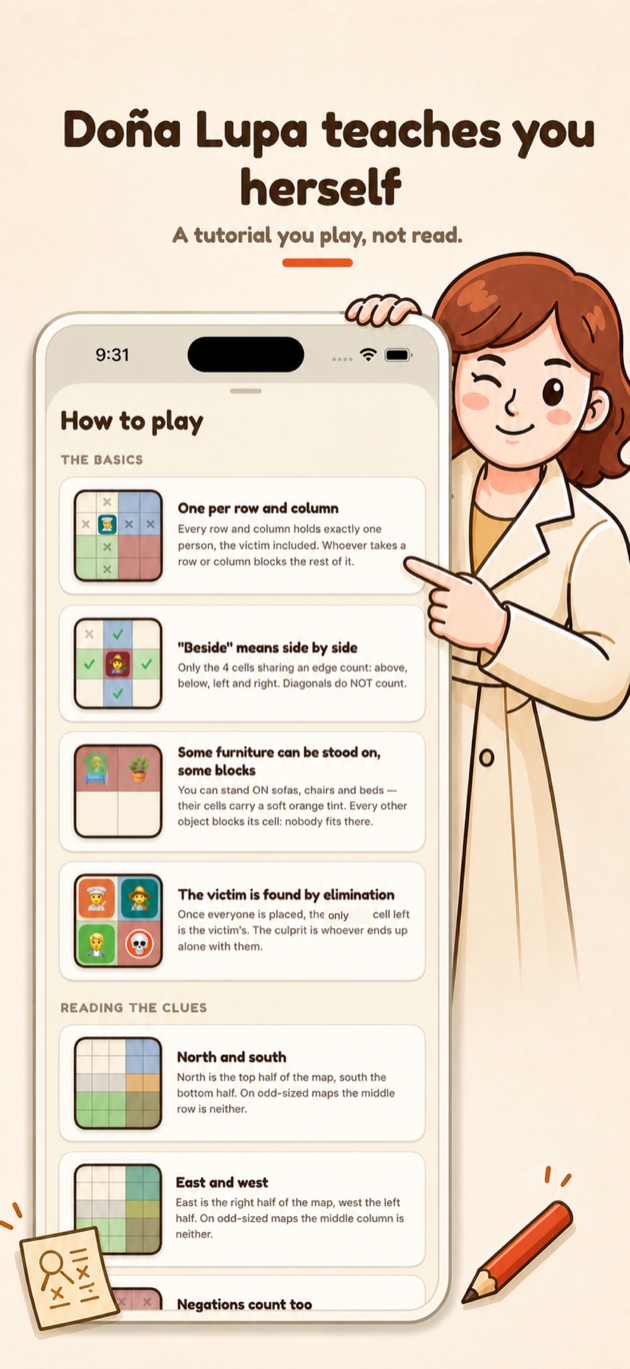
The tutorial waits until you make each deduction.
How to read a stuck board
When no cell looks obvious, choose one suspect and inspect every possible position in a single row, column or zone. If all but one cell are blocked, you have found a hidden single: the answer is forced even though the cell itself had several candidates at first.
Also check intersections. If a suspect can only appear in two cells of a zone and both cells sit in the same row, that suspect cannot appear elsewhere in that row. You do not have to memorize a technical name for the pattern; just ask, “Where can this person still go, and what does that remove?”
Three beginner mistakes to avoid
- Forgetting zones: a placement may be legal in its row and column but still repeat a suspect inside the outlined zone.
- Treating a clue as optional: every clue in Doña Lupa is true. If the board contradicts one, an earlier placement needs another look.
- Guessing too early: two possible cells are not a coin toss. Preserve both candidates and search for the constraint that separates them.
Accuracy beats speed while the rules become familiar. After a few cases, you will stop checking rows, columns and zones separately; you will see their overlap as one deduction.
Quick answers
Deduction-sudoku beginner questions
Do I need to know number sudoku before I play?
No. This format uses one-per-row, one-per-column and one-per-zone constraints, but Doña Lupa teaches them with illustrated suspects and an interactive first case.
Should I guess when two suspects still fit?
Usually no. Leave both possibilities open, inspect the intersecting row, column and zone, and combine another truthful clue. Doña Lupa cases are designed to have one logical solution.