
Inside the case
Murder mystery logic puzzles, explained
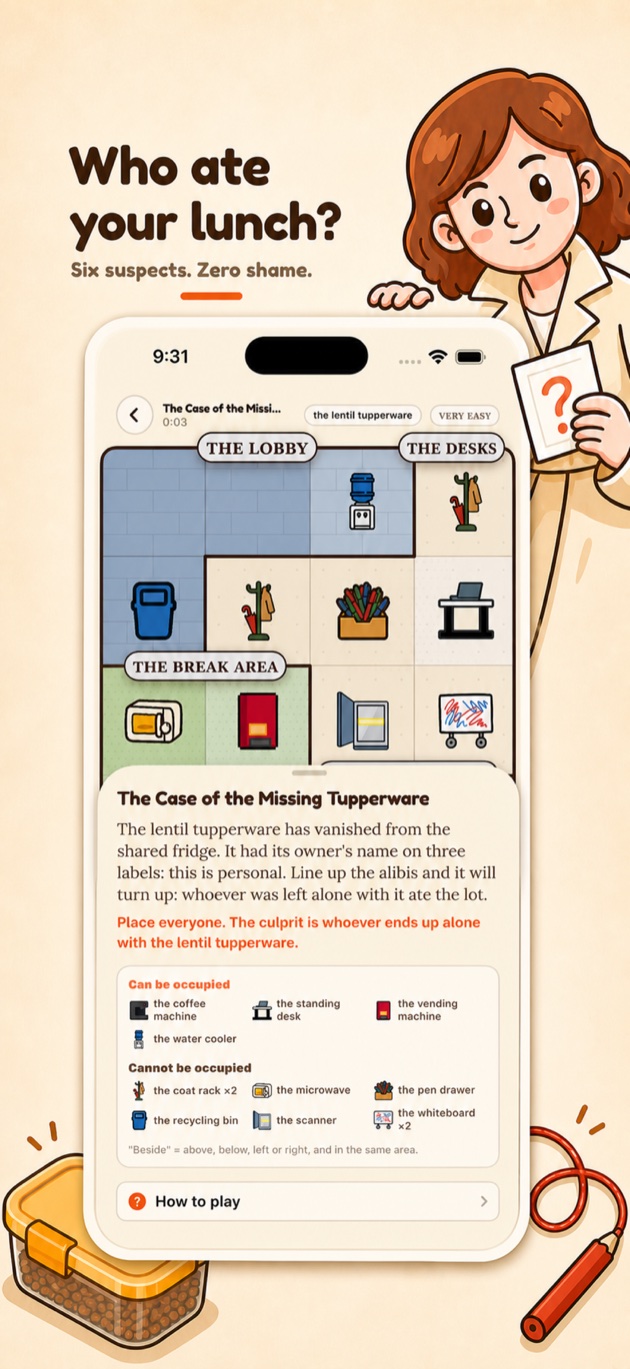
If you enjoy mystery logic puzzles with a lighter story, Doña Lupa offers comic cases about small everyday crimes on iPhone. Four worlds and a daily case wrap truthful clues around sudoku-style suspect placement. Easy cases are free; full access has monthly and lifetime options, with no ads.
A murder mystery logic puzzle gives you a closed set of suspects, truthful evidence and enough constraints to identify one answer. The fun is not spotting a twist the author kept secret; it is turning scattered facts into a conclusion that suddenly feels unavoidable.

Story on top, logic underneath
A traditional whodunit asks you to compare testimony, motive and opportunity. A grid-based mystery keeps that pleasure but makes the logical structure visible. The suspects may be office workers, hotel guests or village regulars; underneath the jokes, each one must occupy a valid position and every clue removes possibilities.
In Doña Lupa, the mystery can be “Who ate the lunch?” rather than a grim crime. That smaller scale matters: it makes room for dry humor while preserving the satisfying part of detective fiction. You still collect evidence, test alibis and expose a culprit. The final confession simply has a better chance of involving a sandwich.
The four parts of a satisfying logic mystery
1. A closed cast
You should know who can appear on the board. A fixed cast lets you reason from absence as well as presence: if five suspects are accounted for in a row, the sixth has nowhere else to go. New characters should not arrive during the reveal to invalidate your work.
2. Honest evidence
A clever clue can be indirect, but it should not lie. “The culprit was not beside the manager” removes cells; “the intern was in the same zone as the coffee” connects two facts. If a sentence depends on an unusual interpretation, the puzzle should teach that meaning rather than spring it on you later.
3. Constraints that interact
One clue rarely solves the whole case. Satisfaction comes from combination. A row rule removes two cells, a zone rule removes another, and a story clue leaves a single position. The answer is produced by the overlap, not by one suspiciously convenient sentence.
4. A single ending
When two complete boards satisfy every clue, the mystery is underdetermined. A fair puzzle has one final arrangement and gives the player a way to verify it. In Doña Lupa, every suspect fits once per row, column and zone, so a completed board checks itself before the comic reveal.
Case file, meet logic grid
Solve cozy mysteries where every clue counts.
How to tell deduction from guessing
A guess chooses between possibilities without enough evidence. A deduction can be written as a short chain: this suspect cannot be here because the row already contains them; that cell is blocked by the zone; therefore only one position remains. You may perform the chain mentally, but every link should be available on the board.
When stuck, resist asking, “Who looks guilty?” Ask narrower questions: Which suspect has the fewest possible cells? Which zone is nearly complete? Which clue has become useful since my last placement? Mystery artwork and dialogue create personality, but neither should override the formal evidence.

Why cozy mysteries work so well as puzzles
Low-stakes crimes keep failure light. You can reconsider a wrong mark without feeling that the story is punishing you, and the cast can be eccentric without becoming threatening. That tone also makes short daily cases pleasant: one neat problem, one culprit, one terrible alibi, then back to your day.
The result sits between a logic-grid worksheet and a detective story. The grid makes the reasoning precise; the story makes each deduction memorable. If you enjoy the structure more than the setting, the next step is to learn a repeatable detective logic-grid solving method. If the rules are new, begin with how to play deduction sudoku.
Quick answers
Mystery puzzle questions
Are murder mystery logic puzzles scary or violent?
They do not have to be. Doña Lupa uses cozy, comic mysteries such as a missing lunch, suspicious coffee or a tiny hotel mishap; the focus is deduction, not realistic crime.
What makes a mystery logic puzzle fair?
A fair puzzle gives you every fact needed, keeps its clues true, avoids requiring hidden knowledge and reaches one solution through deductions you can check on the board.